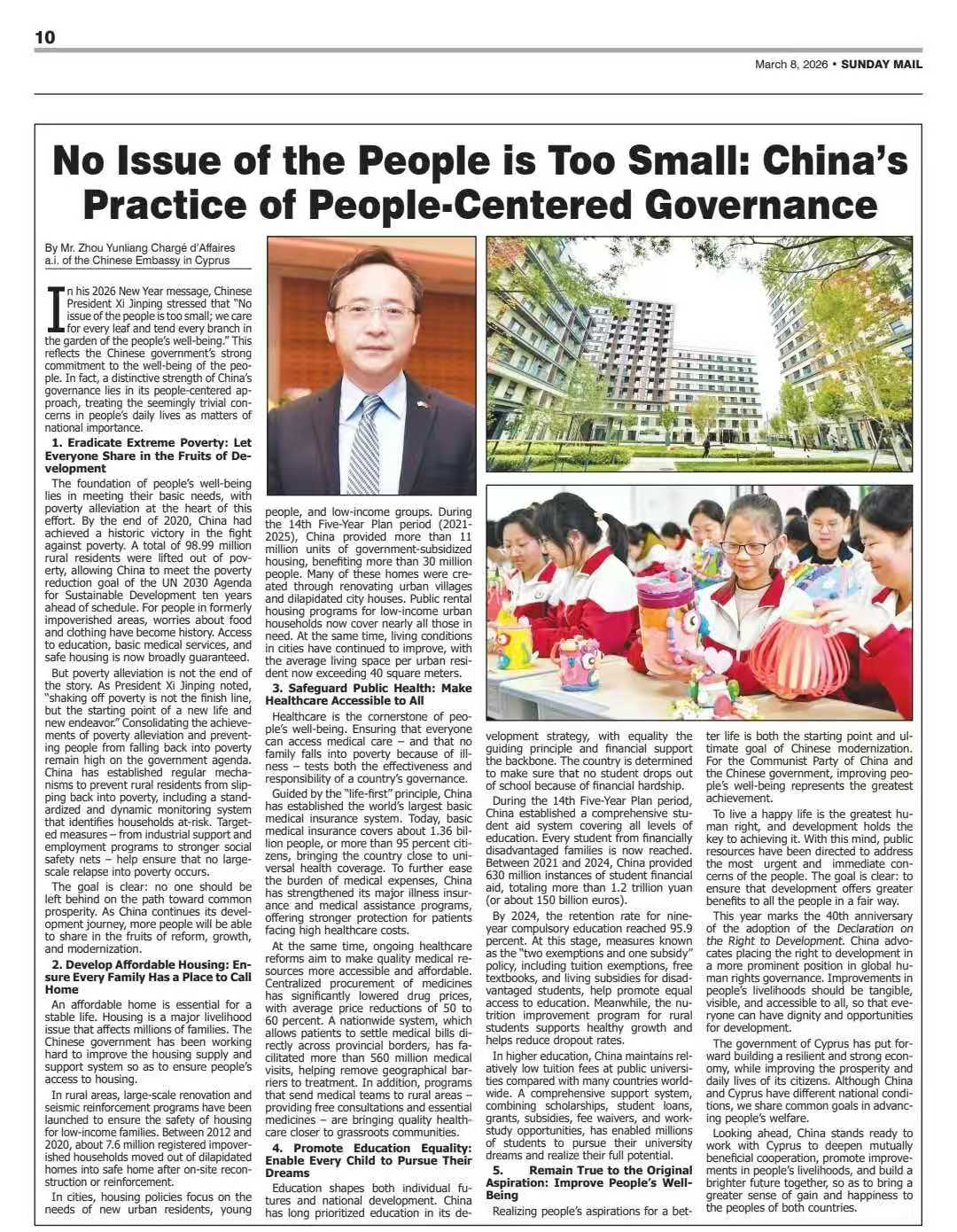
| Chargé d’Affaires a.i. of the Chinese Embassy in Cyprus Zhou Yunliang published a signed article “No Issue of the People is Too Small: China’s Practice of People-Centered Governance” on Cyprus Mail |
| 2026-03-10 00:22:28 |
|
On 8 March 2026, Chargé d’Affaires a.i. of the Chinese Embassy in Cyprus Zhou Yunliang published a signed article titled “No Issue of the People is Too Small: China’s Practice of People-Centered Governance” on Cyprus Mail. The full text is as follows:
In his 2026 New Year message, Chinese President Xi Jinping stressed that “No issue of the people is too small; we care for every leaf and tend every branch in the garden of the people’s well-being.” This reflects the Chinese government’s strong commitment to the well-being of the people. In fact, a distinctive strength of China’s governance lies in its people-centered approach, treating the seemingly trivial concerns in people’s daily lives as matters of national importance. 1. Eradicate Extreme Poverty: Let Everyone Share in the Fruits of Development The foundation of people’s well-being lies in meeting their basic needs, with poverty alleviation at the heart of this effort. By the end of 2020, China had achieved a historic victory in the fight against poverty. A total of 98.99 million rural residents were lifted out of poverty, allowing China to meet the poverty reduction goal of the UN 2030 Agenda for Sustainable Development ten years ahead of schedule. For people in formerly impoverished areas, worries about food and clothing have become history. Access to education, basic medical services, and safe housing is now broadly guaranteed. But poverty alleviation is not the end of the story. As President Xi Jinping noted, “shaking off poverty is not the finish line, but the starting point of a new life and new endeavor.” Consolidating the achievements of poverty alleviation and preventing people from falling back into poverty remain high on the government agenda. China has established regular mechanisms to prevent rural residents from slipping back into poverty, including a standardized and dynamic monitoring system that identifies households at-risk. Targeted measures—from industrial support and employment programs to stronger social safety nets—help ensure that no large-scale relapse into poverty occurs. The goal is clear: no one should be left behind on the path toward common prosperity. As China continues its development journey, more people will be able to share in the fruits of reform, growth, and modernization. 2. Develop Affordable Housing: Ensure Every Family Has a Place to Call Home An affordable home is essential for a stable life. Housing is a major livelihood issue that affects millions of families. The Chinese government has been working hard to improve the housing supply and support system so as to ensure people’s access to housing. In rural areas, large-scale renovation and seismic reinforcement programs have been launched to ensure the safety of housing for low-income families. Between 2012 and 2020, about 7.6 million registered impoverished households moved out of dilapidated homes into safe home after on-site reconstruction or reinforcement. In cities, housing policies focus on the needs of new urban residents, young people, and low-income groups. During the 14th Five-Year Plan period (2021-2025), China provided more than 11 million units of government-subsidized housing, benefiting more than 30 million people. Many of these homes were created through renovating urban villages and dilapidated city houses. Public rental housing programs for low-income urban households now cover nearly all those in need. At the same time, living conditions in cities have continued to improve, with the average living space per urban resident now exceeding 40 square meters. 3. Safeguard Public Health: Make Healthcare Accessible to All Healthcare is the cornerstone of people’s well-being. Ensuring that everyone can access medical care—and that no family falls into poverty because of illness—tests both the effectiveness and responsibility of a country’s governance. Guided by the “life-first” principle, China has established the world’s largest basic medical insurance system. Today, basic medical insurance covers about 1.36 billion people, or more than 95 percent citizens, bringing the country close to universal health coverage. To further ease the burden of medical expenses, China has strengthened its major illness insurance and medical assistance programs, offering stronger protection for patients facing high healthcare costs. At the same time, ongoing healthcare reforms aim to make quality medical resources more accessible and affordable. Centralized procurement of medicines has significantly lowered drug prices, with average price reductions of 50 to 60 percent. A nationwide system, which allows patients to settle medical bills directly across provincial borders, has facilitated more than 560 million medical visits, helping remove geographical barriers to treatment. In addition, programs that send medical teams to rural areas—providing free consultations and essential medicines—are bringing quality healthcare closer to grassroots communities. 4. Promote Education Equality: Enable Every Child to Pursue Their Dreams Education shapes both individual futures and national development. China has long prioritized education in its development strategy, with equality the guiding principle and financial support the backbone. The country is determined to make sure that no student drops out of school because of financial hardship. During the 14th Five-Year Plan period, China established a comprehensive student aid system covering all levels of education. Every student from financially disadvantaged families is now reached. Between 2021 and 2024, China provided 630 million instances of student financial aid, totaling more than 1.2 trillion yuan (or about 150 billion euros). By 2024, the retention rate for nine-year compulsory education reached 95.9 percent. At this stage, measures known as the “two exemptions and one subsidy” policy, including tuition exemptions, free textbooks, and living subsidies for disadvantaged students, help promote equal access to education. Meanwhile, the nutrition improvement program for rural students supports healthy growth and helps reduce dropout rates. In higher education, China maintains relatively low tuition fees at public universities compared with many countries worldwide. A comprehensive support system, combining scholarships, student loans, grants, subsidies, fee waivers, and work-study opportunities, has enabled millions of students to pursue their university dreams and realize their full potential. 5. Remain True to the Original Aspiration: Improve People’s Well-Being Realizing people’s aspirations for a better life is both the starting point and ultimate goal of Chinese modernization. For the Communist Party of China and the Chinese government, improving people’s well-being represents the greatest achievement. To live a happy life is the greatest human right, and development holds the key to achieving it. With this mind, public resources have been directed to address the most urgent and immediate concerns of the people. The goal is clear: to ensure that development offers greater benefits to all the people in a fair way. This year marks the 40th anniversary of the adoption of the Declaration on the Right to Development. China advocates placing the right to development in a more prominent position in global human rights governance. Improvements in people’s livelihoods should be tangible, visible, and accessible to all, so that everyone can have dignity and opportunities for development. The government of Cyprus has put forward building a resilient and strong economy, while improving the prosperity and daily lives of its citizens. Although China and Cyprus have different national conditions, we share common goals in advancing people’s welfare. Looking ahead, China stands ready to work with Cyprus to deepen mutually beneficial cooperation, promote improvements in people’s livelihoods, and build a brighter future together, so as to bring a greater sense of gain and happiness to the peoples of both countries. |