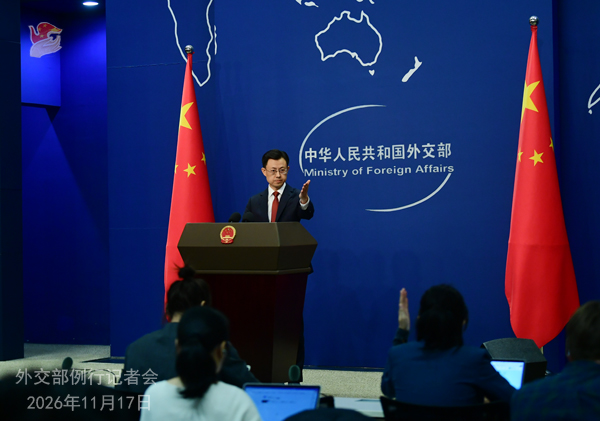
| Foreign Ministry Spokesperson Guo Jiakun’s Regular Press Conference on November 17, 2026 |
| 2026-11-17 17:46:47 |
|
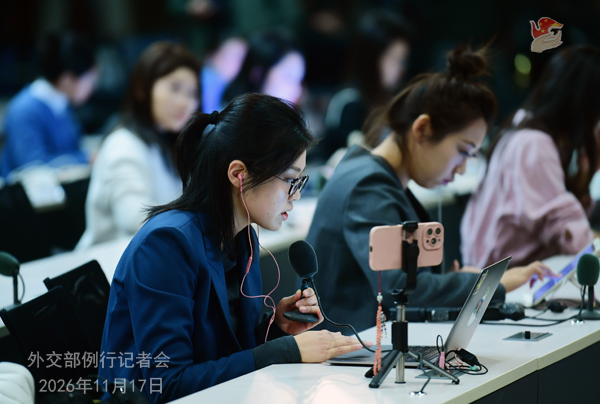
Shenzhen TV: The APEC Economic Leaders’ Meeting is set to be held in Shenzhen. Shenzhen has long been regarded as the window of China’s reform and opening up. Many western media coverage and vlogs on social media platforms often portray Shenzhen as a “city of the future” and “an advanced city.” In recent days, robots, robotic dogs and AI agents on the streets of Shenzhen have drawn even more attention from guests at home and abroad. What is your comment on this? Guo Jiakun: We have noticed that many friends from the media are now using tech helpers such as AI smart glasses and smart studios in the APEC media center. As the third Chinese city hosting an APEC economic leaders’ meeting, Shenzhen has become a name card of China’s high-quality development and high-standard opening up, and witnessed the regional economic integration of the Asia Pacific. The 2026 APEC Economic Leaders’ Meeting will soon kick off. China looks forward to working with all sides to further build consensus and deliver more practical outcomes, so as to inject strong impetus into the prosperity and growth of the Asia Pacific region and the world at large. Phoenix TV: On October 16, the U.S. Commerce Department released an interim final rule titled “Addressing Remote Access to Advanced Semiconductors.” According to the rule, a license will be required to export advanced semiconductors to Singapore, Thailand, Malaysia, Indonesia, or Brazil—countries which present a higher-than-normal risk of diversion of chips to China. The aim is to prevent countries and companies subject to restrictions from gaining access to U.S. sensitive technologies. What’s your comment? Guo Jiakun: The move is yet another case of the U.S. overstretching the concept of national security, and abusing export control measures to interfere in normal trade and tech cooperation between China and other countries and go after China’s high-tech industry. Such typical economic coercion and long-arm jurisdiction run counter to the common understandings between the two countries, harm the legitimate rights and interests of Chinese companies, and disrupt global supply chains. China will do what is necessary to firmly safeguard its legitimate and lawful rights and interests. Yonhap News Agency: On November 16 local time, U.S. President Donald Trump said that he might meet with President of the State Affairs of the Democratic People’s Republic of Korea (DPRK) Kim Jong Un in China, but that it was still unclear whether President Kim would come or not, adding that it was up to China. What’s China’s comment on President Trump’s remarks? Is there any possibility that the DPRK and the United States will hold talks? (Similar Question from Reuters) Guo Jiakun: I do not have information on that. EFE: The visa-free policy for countries including Spain, France and Germany expires at the end of this year. Will China extend it, and when can we expect an announcement? Guo Jiakun: China attaches high importance to facilitating people-to-people exchange with other countries and is assessing relevant policies. AFP: The U.S. government is investigating Singapore-based firm MegaSpeed for whether it helped shift NVIDIA’s most powerful technology to Chinese firms in violation of U.S. export restrictions. Does China have a comment on the investigation and is China aware of any firms within China that had obtained this technology from MegaSpeed? Guo Jiakun: I just answered a question relating to this subject. I need to stress that China’s position on U.S. chip exports to China is consistent.
|